Fall risk assessment tells you who might fall, not when. Here is why the gap between reviews is where falls actually happen, and what operators can do about it.
Every senior living operator assesses fall risk, and most do it well. A fall risk assessment answers one question with reasonable confidence: who is likely to fall? The question that determines whether a fall can actually be prevented is harder for any assessment to reach: when is that resident most at risk?
The gap between those two questions is measurable. Teton’s analysis of 2,000 confirmed falls across care settings in the US, UK, Denmark, and Switzerland, published in Anatomy of 2,000 Falls, classified 79 percent of the reviewed falls as potentially avoidable based on observable circumstances preceding or surrounding the incident. Closing that gap starts with understanding what assessment captures and what it structurally cannot.
Why fall risk assessment matters to operators
The clinical case is settled. Residents identified as high risk receive interventions that measurably reduce falls. The operator case is just as strong. Falls are the leading cause of injury among adults over 65, with more than one in four older adults falling each year, according to the CDC. Each fall risks a hospital transfer that shortens length of stay, consumes staff hours in response and documentation, and draws regulator attention from state survey agencies.
Assessment is where control over all of that begins. Its limitation sits in an assumption every standard tool shares: that risk is a stable property of a person, captured on a form and revisited quarterly.
How are fall risk factors classified?
Clinicians divide fall risk into intrinsic factors, which belong to the resident (age, gait and balance, sensory impairment, cognition, medications, fall history), and extrinsic factors, which belong to the environment (lighting, flooring, footwear, equipment placement).
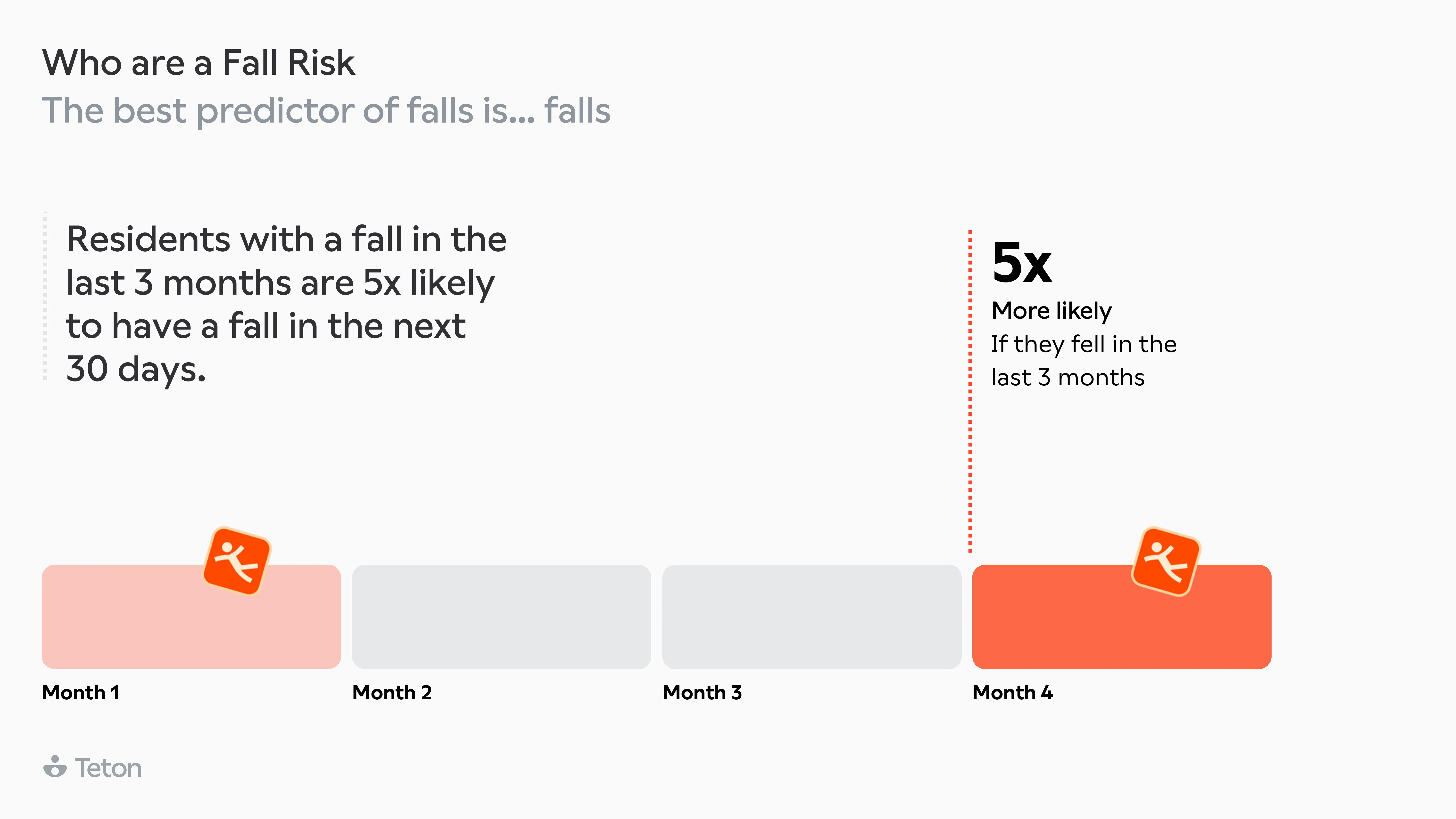
One factor towers over the rest. The Anatomy of 2,000 Falls analysis found that a resident who fell within the past three months is around five times more likely to fall again in the following 30 days, a stronger signal than any other factor measured. This is why every physician asks whether someone has fallen recently, and it also hints at the method’s limits: the best information we have about tomorrow’s fall is yesterday’s.
The extrinsic side carries a similar lesson. In the same analysis, most falls among walking aid users happened while the aid was not in use, frequently because it sat in the room out of reach. No assessment form has a box for where the frame is parked at 2 a.m.
What is the Morse Fall Scale?
The Morse Fall Scale is the instrument most operators will recognize. It scores six variables, including fall history, gait, mobility aid use, and mental status, and bands residents into low, moderate, and high risk. The Hendrich II model applies the same logic with inputs weighted toward medication effects. Both are validated, fast, and useful for directing attention across a building.
What deserves scrutiny is the assumption underneath them. A score treats risk as stable until the next review, while anyone who has spent time in care settings knows risk moves with infections, medication changes, and poor nights. UK guidance has already shifted in this direction: NICE now advises against relying on risk prediction tools alone, favoring comprehensive assessment of individual risk factors.
The Anatomy analysis also identified two strong warning signals that appear on no checklist: deteriorating sleep regularity and rising overnight respiration, both of which often precede the infection or decline that leads to a fall. They stayed off the checklists for a simple reason. Until recently, nobody could measure them routinely.
When do falls actually happen?
Ask any experienced night nurse and they will answer before any dataset does: the dangerous hours are the small ones. The Anatomy data quantifies the instinct. A bed exit at 3 a.m. was roughly 60 percent more likely to end in a fall than the same movement in the afternoon, and getting out of bed was the most dangerous transition a resident makes, more so after a long period lying still.
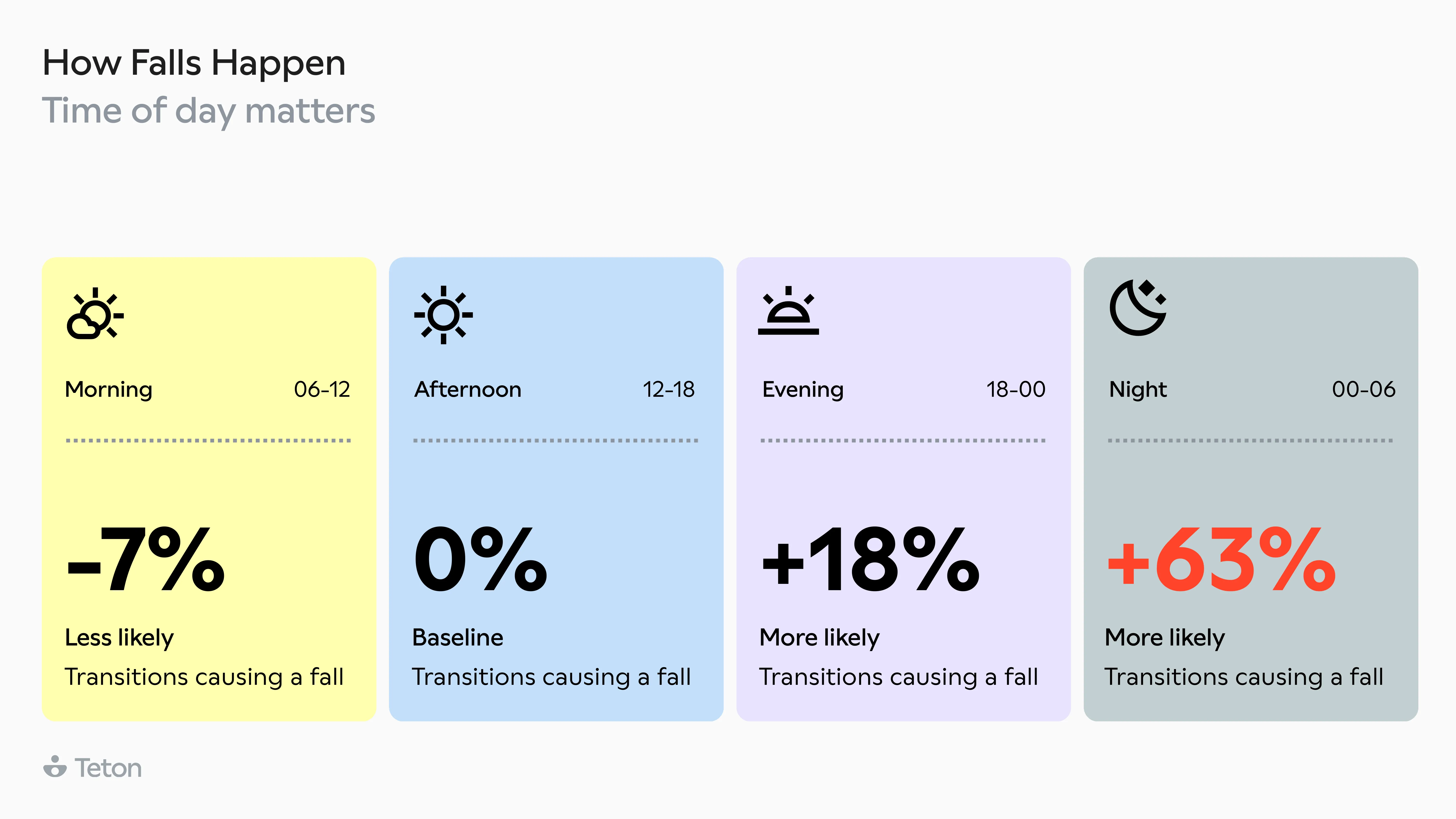
Fall risk concentrates overnight, precisely when staffing is thinnest and observation depends on rounds spaced hours apart. The resident who scored moderate at last month’s review can meet the week’s highest-risk moment alone, in the dark, unwitnessed. This makes falls at night a leadership issue rather than a clinical one. The assessment establishes baseline risk. It was never designed to identify the specific night when that risk suddenly rises, and only leadership can close that gap.
What should operators do differently?
Three shifts turn this from insight into an operating model.
First, treat a fall as the beginning of a high-risk period, not the end of an incident. The fivefold elevation in risk persists for around 90 days. That warrants a defined post-fall protocol with an owner, a duration, and a review cadence, rather than informal extra vigilance.
Second, align workflows to moments of risk, not only categories of risk. Audit whether your nighttime workflows concentrate attention where risk is actually rising: night bed exits, toileting patterns, mobility-aid availability, changes from baseline. The answer is not necessarily more observation. It is better information about which residents require attention, and when.
Third, combine scheduled assessment with continuous evidence. Passive room sensing can show how a resident actually spent their nights and trigger reassessment when behavior no longer matches the care plan. Fall detection is the safety net this technology is known for; its quieter value is upstream. To be precise about the boundary: continuous observation produces no clinical score and replaces no one’s judgment. It changes the evidence judgment works from.
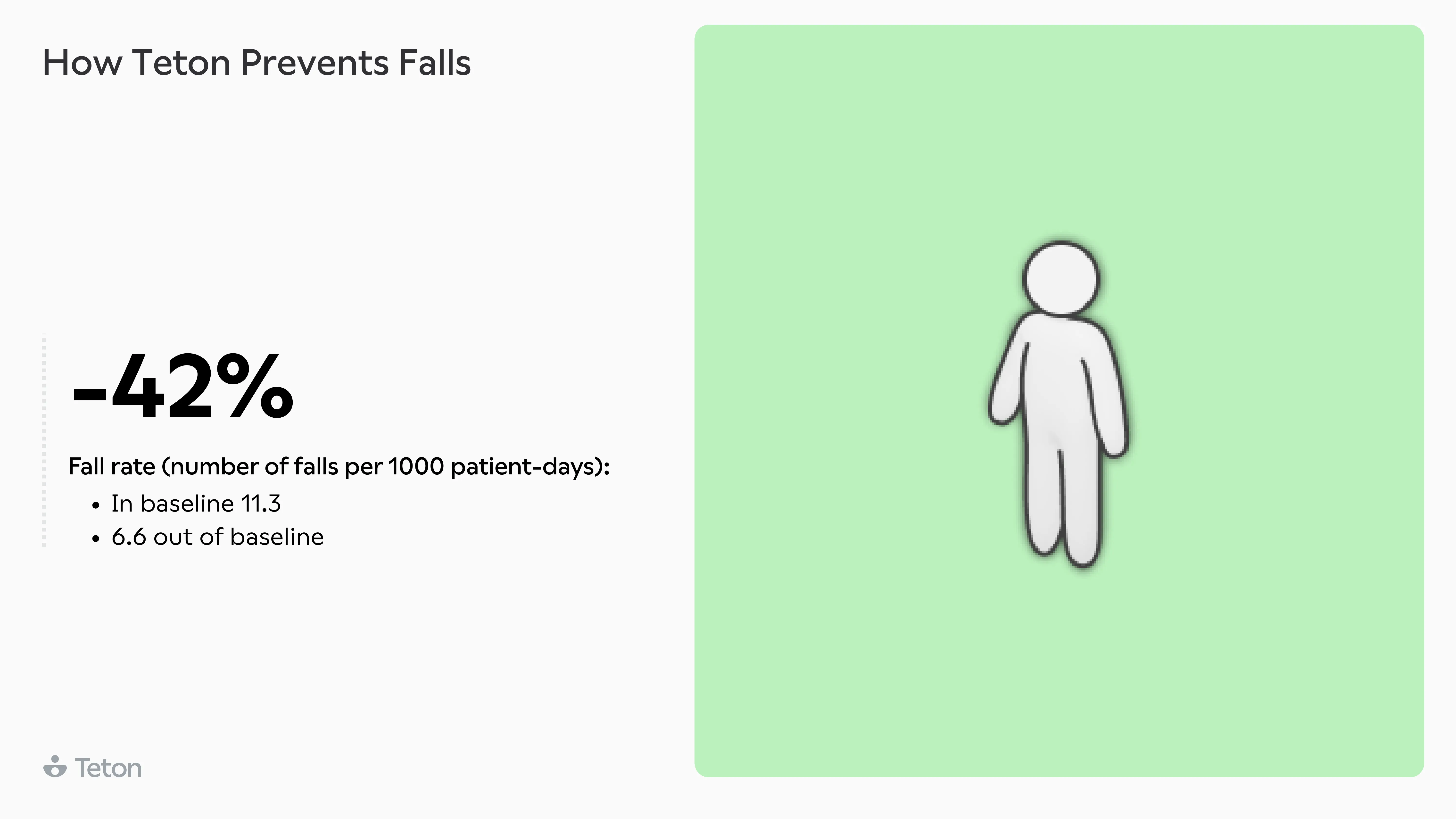
Where this pairing operates, the results are worth knowing. Communities in the Anatomy analysis cut fall rates by 42 percent, and the remaining barriers to the 79 percent figure were operational, not scientific. For operators, that is good news. Operational problems are the kind we know how to solve.
When should a fall risk assessment be reviewed?
The established guidance holds: on admission, after any fall, after any significant change in condition or medication, and at regular intervals. The post-fall data argues for tightening it, with elevated attention held for at least 90 days.
The more honest answer is that risk changes daily and no schedule can. The mature position treats the score and the picture as two halves of one discipline: scheduled assessment to set the plan, continuous evidence to show when the plan has stopped matching the resident.
See what the data shows
This piece draws on Teton’s analysis of 2,000 confirmed falls and 3 million movement transitions, published in Anatomy of 2,000 Falls. To see how continuous observation works alongside your assessment process, book a demo.