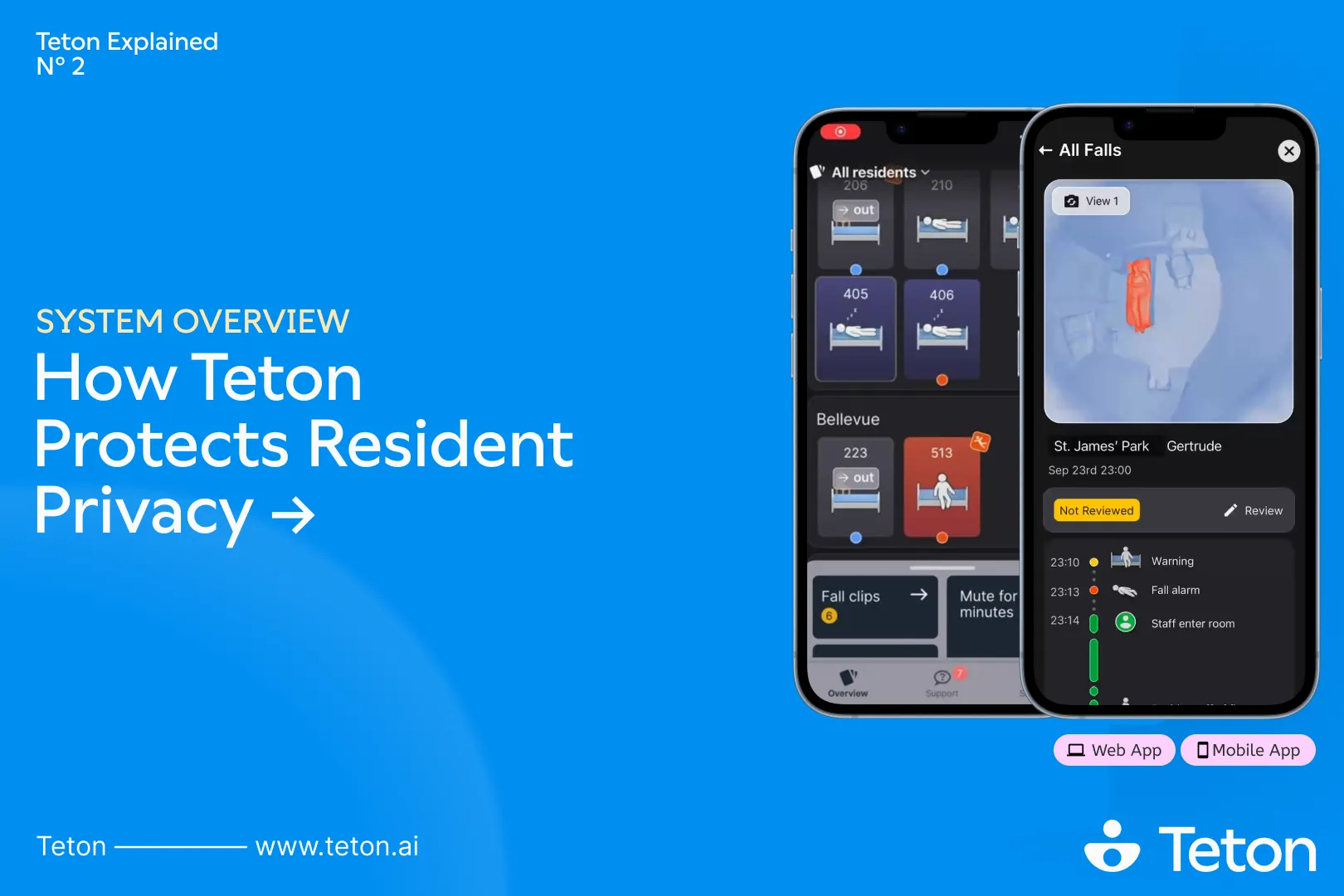
Teton System Overview: How Teton Protects Resident Privacy (Teton Explained #2)

February 11, 2026
Teton Explained

Who We Are

Teton empowers care by helping teams see risk sooner and act earlier, so care quality improves even when resources are stretched.

Summary

  • Teton uses a sensor to track motion
  • Teton does not use live video
  • Data processing happens in the room
  • Only anonymized animations leave the room to inform care staff in the case of an incident
  • Resident participation is always voluntary

Dignity, Not Surveillance

The most common concern families have about monitoring solutions in senior care is if staff will be watching their loved one throughout the day. The worry is understandable, nobody wants their parent or grandparent to feel like they're living under surveillance, observed in their most private moments.

Teton is fundamentally different from surveillance. There is no live video feed for staff to watch. No one sits in a monitoring room observing residents go about their day. The system doesn't work that way, and it's not designed to work that way.

This distinction matters deeply for dignity. A resident can change clothes, use the bathroom, have an intimate conversation with a visitor, or simply enjoy solitude in their own space, knowing that no one is watching.

It means maintaining dignity and independence, while having a safety net that responds quickly if something goes wrong.

This article explains how Teton's system works, how we protect resident privacy at every layer, and how we approach the responsible use of data to improve our technology.

The Core Principle: In-Room Computing

Most monitoring systems send video from resident rooms to the cloud, where it’s processed and stored for analysis. That means raw footage moves across networks, lives on remote servers, and can be accessed far from the point of care. Even with strong safeguards, this model can increase exposure of highly sensitive data.

Teton is built differently.

We process data directly inside the room, using a dedicated compute unit paired directly locally with the sensor. Analysis happens locally, at the point of care, so raw visual data never leaves the room and never reaches our servers.

The device connects to one or more sensors via wired connections. The sensors themselves are even more isolated. They connect directly to the edge device via a wired connection and have no wireless network connectivity.

This design dramatically reduces data exposure by ensuring the most sensitive information simply never exists outside the resident’s room.

Only essential, purpose-built outputs are shared beyond the room:

  • Safety events (e.g., fall detected)
  • Health and activity signals (e.g., respiration, sleep status)
  • Brief, pseudonymized silhouette clips for incident review

The following diagram illustrates how data flows through the Teton system:

The data that leaves the room is limited to numeric and event-based: a notification that a fall was detected, a measurement of respiration rate, a record that the resident transitioned from sleeping to awake. When staff need to review what happened during a fall, they see an animated representation of the incident.

Consent, Transparency, and Family Involvement

Technology in private living spaces should always be implemented with resident consent and full understanding of the technology. Before Teton is activated in a resident’s room, residents and families are informed:

  • How the system works
  • What data is processed locally
  • What information leaves the room
  • What the system does and does not do

Participation is voluntary and consent is obtained in line with local regulations and care provider processes globally.

We treat consent as an ongoing relationship, not a one-time checkbox.

We see families as active partners in care. Teton often supports clearer, more informed conversations between care teams and families about safety, changes in mobility or sleep, or how a fall occurred without exposing residents to unnecessary intrusion.

When questions arise, families can be shown exactly what information exists and how it is used, helping build confidence in both the technology and the care being delivered.

The Advantages of Passive Ambient Monitoring

The passive ambient monitoring technology used by Teton provides insight without relying on wearables, which often fail in real-world care settings.

Wearables can be helpful in some contexts. In senior care environments, however, they frequently introduce gaps.

Residents and staff forget to wear wearables, remove them for comfort, misplace them, or experience battery and hardware failures. Devices can break, be left charging, or be rejected by residents with cognitive impairment.

As a result, the moments when monitoring is most needed such as overnight, during confusion, or after a fall, are often when wearables are not available. This creates unavoidable blind spots.

These blind spots limit the ability to deliver consistent safety and personalized care.

By contrast, Teton’s passive ambient monitoring technology can:

  • Reliably detect real falls while avoiding false alarms
  • Model individual sleep and mobility patterns over time
  • Distinguish residents from staff and measures that number of staff visits
  • Reconstruct incidents meaningfully for prevention and review

This contextual understanding enables personalized care. Longitudinal insights such as gradual changes in nighttime behavior, mobility, or rest patterns require a stable, resident-specific signal that works continuously, without relying on residents to remember or tolerate a device.

Crucially, Teton achieves this continuity while preserving dignity and privacy.

Faster Help When It Matters Most

Teton’s architectural choice isn’t just about privacy, it enables speed.

Because fall detection runs locally, there is no delay waiting for video to upload or be reviewed elsewhere. When a fall happens, alerts are sent to staff within seconds, day or night.

Across live deployments globally, care teams have observed consistent improvements in safety and outcomes:

  • Average number of falls is reduced by ~40%
  • Average fall response times are reduced by 96%

Faster response changes what happens after a fall, and before the next one. After a fall, the next time a residents sit on the bed edge, Teton will send an alarms to staff to prevent a fall from happening at all.

Faster response also means:

  • Less time spent on the floor after a fall
  • Lower risk of complications related to prolonged immobility
  • Reduced anxiety for residents who know help arrives quickly

For families, this builds confidence. For operators, it leads to fewer ER transfers, less escalation of minor incidents, and measurably better outcomes without increasing staffing burden.

Health Insights That Enable Personalized Care

Beyond safety, Teton continuously measures trends that help staff understand residents over time:

  • Sleep duration and fragmentation
  • Bathroom visits during day and night
  • Respiration rate while in bed
  • Daytime bed rest and activity patterns

These insights provide continuity in environments with shift changes and staff turnover, helping teams notice gradual changes that might otherwise be missed.

Care teams report this supports:

  • More personalized daily care
  • Smoother shift handovers
  • Earlier conversations when something feels “off”

These insights do not diagnose or replace clinical judgment.

How Animated Clips Prevent Future Falls

When a fall occurs, care teams need to understand what happened to make informed decisions. Did the resident trip? Did they lose their balance reaching for something? Understanding the circumstances helps prevent future incidents and informs care planning:

  • Assessing injuries
  • Preventing future incidents
  • Communicating clearly with families and regulators

To support this without compromising privacy, Teton generates animated clips rather than identifiable video. These clips use a depth-based rendering technique that generates the essential information without identifying features.

In an animated clip, you can see body position and posture, which tells staff whether the resident was standing, sitting, or lying down before the fall. You can see the trajectory of movement, showing how the fall unfolded. You can see spatial relationships, like whether the resident was near the bed or in the middle of the room. But you cannot see facial features, skin tone, clothing details, or anything else that would identify the specific individual.

  • Body posture and movement are visible
  • Spatial context (bed, bathroom, floor) is preserved
  • Facial features, clothing, and identifying details are removed

The result looks something like a silhouette or shadow figure moving through space. Staff can understand exactly what happened during the incident, but even if this clip were intercepted or improperly accessed, it would be impossible to identify who was in the video.

This approach gives care teams the insight they need without turning vulnerable moments into surveillance footage.

Example of an animated fall clip:

Access Controls and User Permissions

We created different levels of permissions within a care community to ensure the right person has the right information.

Teton uses role-based access control aligned with real care workflows. Caregivers, nurses, administrators, and IT staff each see only what is necessary for their role.

We integrate with Auth0 to support single sign-on and multi-factor authentication.

All access changes are logged with full audit trails, and access can be revoked immediately when roles change.

Conclusion

Teton's approach to privacy and security can be summarized in the following key principles.

  • First, we involve residents and families in decisions about how Teton is used, through clear communication and informed, voluntary consent, in which we've seen a 99% opt-in rate.
  • Second, we design for security from the network level up, with sensors that never touch the network. We minimize data exposure by processing all sensitive data locally and transmitting only events and metrics. The most sensitive data never leaves the room.
  • Third, when a review is needed to understand an incident, we generate animated clips that preserve relevant context while removing identifying features.
  • Fourth, we implement comprehensive access controls and security best practices to ensure that the data we do collect is protected and that access is appropriate and accountable.

These principles guide every decision we make about how Teton works. Privacy isn't a feature we added; it's the foundation we built on. That foundation allows us to use technology for what it should do best in care: help residents live safely and independently, give families peace of mind, and support care teams in being present when it truly matters.

Learn More

For additional information about Teton's resident privacy practice and compliance certifications, visit our Trust Center at trust.teton.ai.

For questions about Teton's technical architecture or to discuss your organization's specific requirements, contact your Teton representative or reach out to our team at security@teton.ai.

This article reflects Teton's architecture as of January 2026.