Key points
- •Teton uses motion-tracking sensors without live video
- •Data processing occurs locally within resident rooms
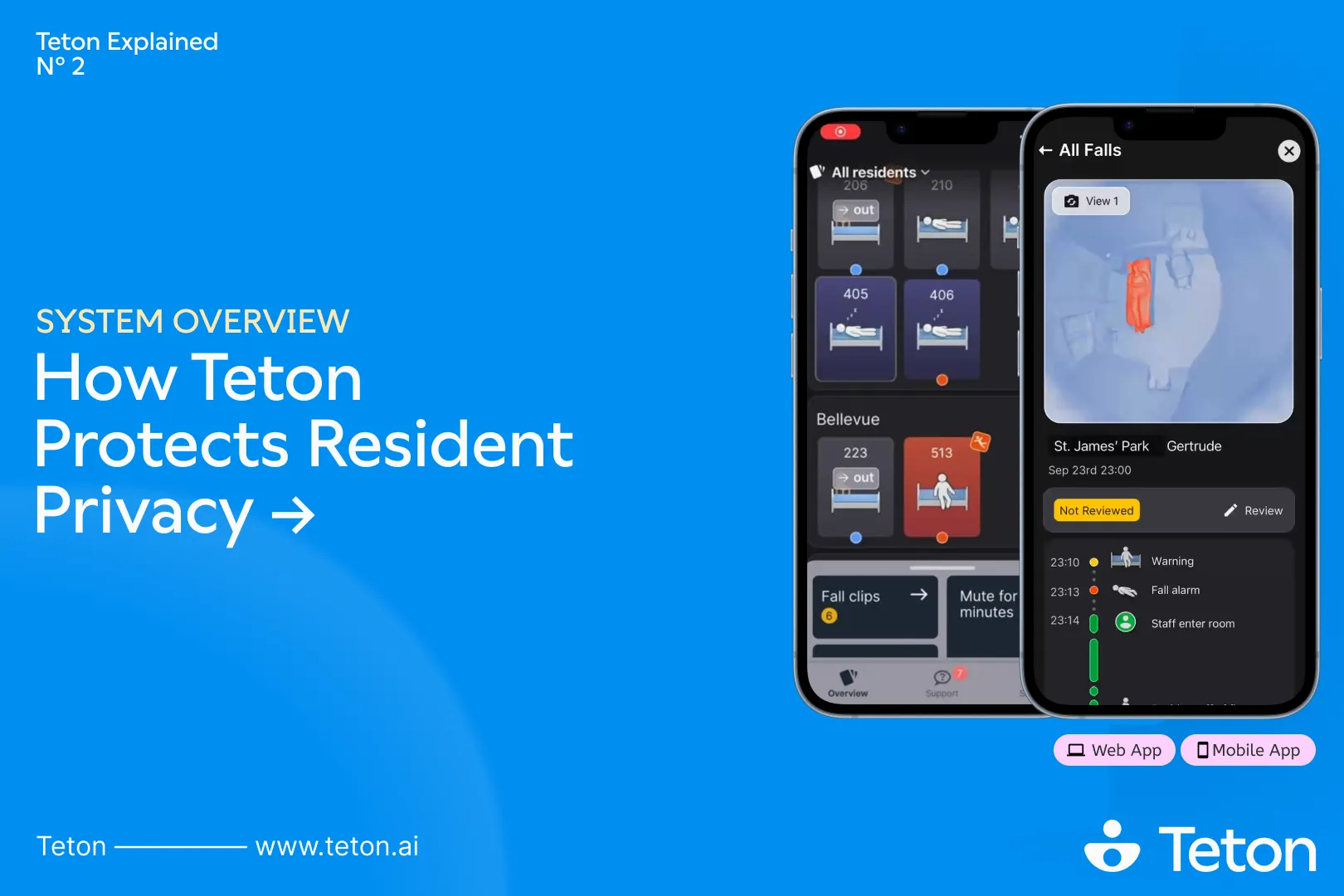
- •Only anonymized animations and events leave the room
- •Resident participation remains voluntary
February 11, 2026·Teton Explained

Key points
Families worry that monitoring systems enable constant observation. Teton is fundamentally different. There is no live video feed for staff to watch. No one sits in a monitoring room observing residents go about their day.
This architecture preserves dignity by ensuring residents can change clothes, use bathrooms, and enjoy private moments knowing nobody is watching. The sensor understands activity and posture, not identity.
Traditional systems transmit video to cloud servers, creating exposure risks at every stage. Teton processes data locally using a dedicated compute unit paired directly with the sensor. Raw visual data never leaves the resident's room and never reaches Teton's servers.
Sensors connect via wired connections only, with no wireless network connectivity on the sensors themselves. Only essential, purpose-built outputs are shared beyond the room: safety events, health signals, and pseudonymized silhouette clips for incident review.

Before activation, residents and families learn how the system operates, what data stays local, what information exits the room, and the system's capabilities and limitations. Participation is voluntary and consent is obtained in line with local regulations.
Across deployments, a 99% opt-in rate has been observed. Consent is treated as an ongoing relationship, not a one-time checkbox. Care teams revisit it as circumstances change.
Wearables frequently fail in care settings. Residents forget them, remove them for comfort, or lose them. Teton's passive approach requires nothing from the resident. It provides reliable fall detection without false alarms, sleep and mobility pattern tracking, staff visit counting, and incident reconstruction for prevention.
Local processing eliminates upload delays. Results across deployments:
~40%
Average reduction in falls
96%
Faster fall response times
Less
Time spent on floor after incidents
Lower
Complication risks
The system continuously measures sleep duration and fragmentation, bathroom visit patterns, respiration rates during rest, and daytime mobility and bed rest. These insights support personalized care plans and smoother shift transitions.

When falls occur, staff need context without identifying footage. Teton generates depth-based silhouettes showing body posture and movement, spatial relationships, and movement trajectory.
You cannot see facial features, skin tone, clothing details, or anything else that would identify the specific individual. The clip provides enough context for clinical teams to understand what happened and take preventive action.
Role-based permissions aligned with care workflows ensure appropriate data access. The system integrates Auth0 for single sign-on and multi-factor authentication, with complete audit trails for every action.
Informed, voluntary consent
99% opt-in rate observed across deployments
Security-first design
Minimal data exposure, local processing, wired connections
Animated clips, not video
Context preserved while identifiers are removed
Comprehensive access controls
Role-based permissions, MFA, complete audit trails
Privacy isn't a feature we added. It's the foundation we built on.
Learn more
Visit our Trust Center for detailed security documentation. For security inquiries, contact security [at] teton [dot] ai.
Teton Explained #1
Fall Review Clips: How Clear Context Changes Fall Response