Generative world models are transforming how AI systems learn, simulate, and reason about the physical world. These models allow AI to build rich, predictive representations, similar to human mental models, that support better decision-making and safer interactions in complex, dynamic environments.
Today, we're introducing Cassandra, a generative world model for healthcare, trained on 140 million real-world behavioral events to predict and simulate how care environments evolve. Cassandra learns patterns in residents' behavior, daily routines, and interactions with caregivers and their surroundings.
Cassandra’s rich, predictive representations enable a wide range of applications, from predicting falls and simulating potential interventions to anticipating residents’ needs. Ultimately, these capabilities will help staff deliver more proactive, personalized care.
We're already seeing these capabilities emerge. In the example below, Cassandra identifies elevated fall risk more than three minutes before the fall occurs. Without being explicitly programmed to recognize these patterns, the model learns both which residents are generally at higher risk of falling and how specific behaviors, such as repeated attempts to get out of bed, changes in how they walk, and furniture surfing, increase that risk.
Loading the room…
Cassandra allows us to explore potential interventions. For example, Cassandra has learned that the position of a walking aid is strongly associated with fall risk for certain residents. This relationship wasn't explicitly programmed into the model, but has emerged from learning patterns in real-world behavior. It matches what we found in Anatomy of 2,000 Falls, where two-thirds of falls among walking-aid users happened when the aid wasn't being used.
Try moving the walking aid in the 3D scene below to see how its position changes Cassandra's predicted risk of a fall within the next five minutes.
Loading the room…
Predicted risk of resident falling within the next five minutes
Beyond predicting individual events, Cassandra can simulate long-horizon future timelines, which enables us to explore how those futures might change under different circumstances.
In the example below, we explore how an afternoon nap might affect a resident's sleep by comparing their actual night with a counterfactual simulation. On their actual night, the resident went to bed at 19:22 and slept for around 10 hours. When we introduce a two-hour afternoon nap, Cassandra simulates a bedtime 47 minutes later, with shorter and more fragmented sleep. Nobody taught the model this link between daytime naps and nighttime sleep. Instead, it discovered these correlations directly from our behavioral data.
Afternoon: no nap
Tonight
Asleep Awake in bed Forecast starts
Cassandra captures dependencies spanning multiple days. In the example below, we introduce a counterfactual fall with an injury into a resident's history and simulate the following day. Instead of spending time outside their room, the simulated resident remains in a wheelchair, requires significantly more assistance, and receives multiple staff-assisted transfers.
Yesterday: an ordinary day
Today

 Staff visit
Chair Wheelchair
 Standing
 Walking with aidOut of sight
 In bathroomStaff-assisted transfer
From scenes to behavioral tokens
A key challenge of building a Generative World Model for healthcare is creating a rich representation of how the care environment evolves over time.
Over the past several years, we've developed spatial AI that makes care environments machine-readable. Running locally on our edge devices, it continuously captures resident activities, falls, wellbeing, and interactions with care staff, without requiring any wearables or manual input.
These observations are encoded as compact, temporal behavioral tokens describing activities, states, and transitions. Each token can represent anything from a brief transition to a state lasting several hours. This makes the representation far more compact than processing every video frame, allowing Cassandra to learn long-term behavioral patterns that unfold over days, weeks, or even months.
Generative Pre-Training: Next-token prediction yields emergent abilities
Cassandra is trained to predict the next event and when it will occur. By autoregressively sampling and appending predictions, the model generates long-horizon future timelines, much like how language models generate text.
Through this simple objective, Cassandra learns rich representations of residents' behavior, routines, and care needs, providing a general foundation for downstream applications such as fall prediction.
Scaling laws for generative behavioral models
Scaling laws have been fundamental to the development of large language models, showing predictable improvements as training data, model size, and compute increase. We found that a similar relationship holds for generative models of human behavior.
Cassandra Scales Like LLMs
More behavioral data, better predictions.
Training Cassandra on progressively larger datasets of up to 140 million behavioral tokens revealed remarkably similar scaling behavior. Prediction loss follows a power law with an exponent of −0.099, strikingly close to the −0.095 reported in early language-model scaling research [1]. While the experiments are not directly comparable, the similarity is encouraging.
We found that more compute alone is not enough: access to large-scale behavioral data is critical. Unlike text, high-resolution longitudinal data of human behavior cannot simply be collected from the internet. It requires real-world deployment, reliable perception, and continuous observation over time.
Compute Isn’t Enough: You Need Data
Loss plateaus when you hit the limits of your data.
With years of deployed infrastructure and a rapidly growing dataset, we believe Teton is uniquely positioned to explore how far generative world models for healthcare can scale.
Architecture and training
Resident activity and care delivery contain dependencies across vastly different timescales, from getting out of bed in seconds to gradual changes in wellbeing over weeks or months.
To capture these long-term dependencies, Cassandra uses Mamba [2], a selective state-space architecture that maintains a compact representation of historical events. Its linear scaling with sequence length makes it practical to model much longer histories than with full Transformer attention.
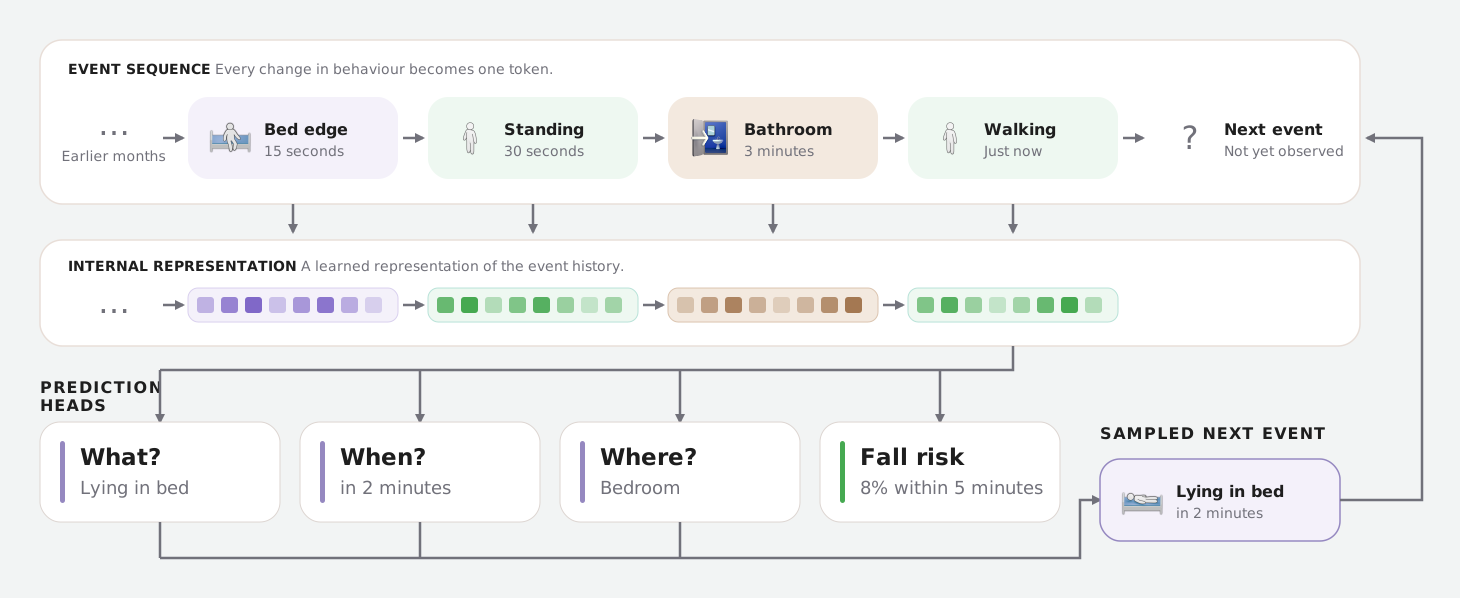
Cassandra predicts what happens next, when and where it happens, and, through a dedicated prediction head, the risk of a fall.
Predicting when something happens is particularly challenging. A resident lying in bed may get up in seconds or remain there for hours. Accurately predicting the timing requires understanding both the resident's usual routines and their current situation.
We model time using an event-conditioned dwell-time head that predicts a probability distribution over time intervals for each possible next event. During training, we supervise the time distribution corresponding to the observed event. During generation, we sample an event and use its corresponding distribution to sample the time until it occurs. We discretize time into buckets rather than regressing a single duration. This lets the model represent multiple plausible timescales, allowing Cassandra to capture multiple plausible timescales, from rapid transitions to hours of uninterrupted sleep.
What's next
We believe Cassandra is just the beginning of what generative world models can enable in healthcare. Fall prediction is our first application, but the real opportunity lies in building a general-purpose model that understands how residents, caregivers, and care environments evolve and interact over time.
As Cassandra scales with more data, compute, and richer observations, we expect increasingly powerful capabilities to emerge. Our ambition is to move beyond predicting what will happen to simulating what could happen, helping care teams identify potential interventions before problems arise.
Ultimately, our ambition is to move healthcare from reactive to proactive care, augmenting the expertise of care workers with AI to anticipate needs, prevent incidents, and deliver better, more personalized care at scale.
If you're excited about building world models that have a real impact on people's lives, we'd love to hear from you.