Sundowning in dementia peaks exactly where staffing troughs. In this blog, we cover why the hardest hours meet the thinnest staffing, and what a million nights of sleep data can teach care providers.
Dementia is a defining condition of modern residential care. 44 percent of US assisted living residents have an Alzheimer’s or dementia diagnosis, a share that has risen steadily for a decade, and around 70 percent of UK care home residents live with dementia or severe memory problems. For most operators, dementia care has stopped being a specialism and become the core business.
Among its most demanding features is a pattern families increasingly ask about by name, often within days of hearing the word from a doctor or memory clinic. Sundowning in dementia is the late-day onset of confusion, agitation, and restlessness in people living with dementia. For operators it is a workload pattern as much as a symptom.
Teton’s resident sleep analysis, published in One Million and One Nights, shows what the hardest hours of the day actually contain.
What is sundowning in dementia?
Sundowning describes a pattern of confusion, anxiety, and restlessness from the late afternoon which can extend deep into the night. It appears most often in the middle and later stages of dementia and varies from resident to resident and day to day.
The causes are not fully established. Reviews of the research identify disrupted circadian rhythm as the most accepted mechanism, driven by degeneration in the brain’s sleep-wake pacemaker as dementia progresses. Accumulated fatigue, fading light, hunger, pain, and the noise of end-of-day routines all compound it.
Guidance from the National Institute on Aging and the Alzheimer’s Society recommends consistent routines, daytime light and activity, and calm evenings. All of it is sound for an individual, but it does not address what happens when thirty residents move through this window at once, on the thinnest staffing of the day.
What time does sundowning happen?
Late afternoon into evening, with effects on sleep that run through the night. For operators, the more useful answer is that sundowning peaks almost exactly where staffing troughs. The day shift is leaving, the evening shift is stretched across dinner and medication rounds, and night cover is the smallest team in the building.
The million-nights data shows what that team is actually covering. The median resident wakes five times a night and leaves bed twice, usually including a bathroom visit. Across a thirty-bed dementia unit, that is roughly one hundred and fifty wake-ups and sixty bed exits a night.
Analysis of 2,000 confirmed falls found fall risk elevated by around 63 percent in those same hours. Night amounts to a shift’s worth of need, distributed across the fewest hands of the day.
Why the scheduled round can’t see it
Sleep in later life is profoundly individual. Across Teton’s research of a million nights, total sleep spread evenly from about four hours to eleven. Two residents can keep identical schedules and have entirely different nights.
The analysis also found that routine checks themselves materially disrupt rest. The scheduled round wakes residents who were asleep and misses those quietly deteriorating, because the pattern that predicts trouble builds across consecutive nights where no single check can see it.
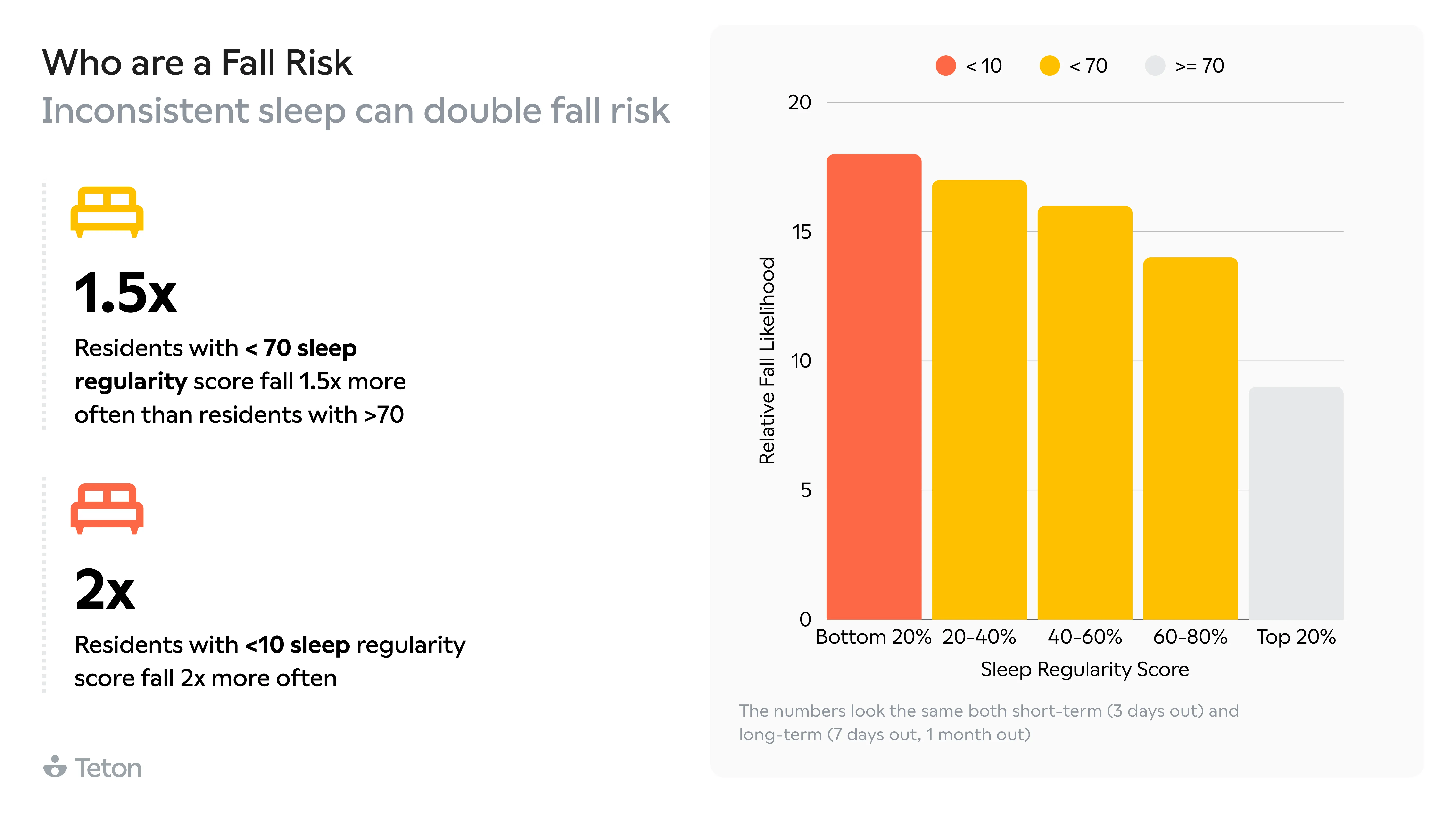
Residents with irregular sleep were 1.5 times more likely to fall, and for a resident with dementia and sleep already fragile, one broken night shapes the whole next day. Meanwhile the knowledge the night team does gather lives in memory rather than the record, and most of it evaporates at the 7 a.m. handover.
What can operators do?
Three shifts follow. Treat late afternoon through night as the workload peak it is, and set handover timing, evening activity, and deployment around that curve. Make night observation part of the care record, so what the night team learns informs the next day’s care instead of disappearing at handover.
And give the shift current evidence. Teton’s continuous, passive monitoring shows who is asleep and should be left undisturbed, who is restless tonight, and whose sleep has deteriorated across the week, so attention goes where the need is rather than where the schedule assumed.
The results are measurable. Residents in communities using Teton now sleep nearly an hour longer on average, with an 8 percent rise in sleep efficiency, partly because staff time rounds around who is actually awake.
Monitoring will not diagnose sundowning, explain a resident’s distress, or replace the judgment of the people in the building. Its contribution is narrower. It shows where the night’s attention should go, so the hardest hours of the day run on evidence rather than habit.