← Back to blog

Engineering & Technology · 7 min read

Ambient Gait Assessment with Teton

Every step tells a story about a resident’s health and wellbeing. Our latest field validation shows how Teton accurately measures everyday gait, helping care teams detect changes early and provide more proactive, personalized care.

October 30, 2026

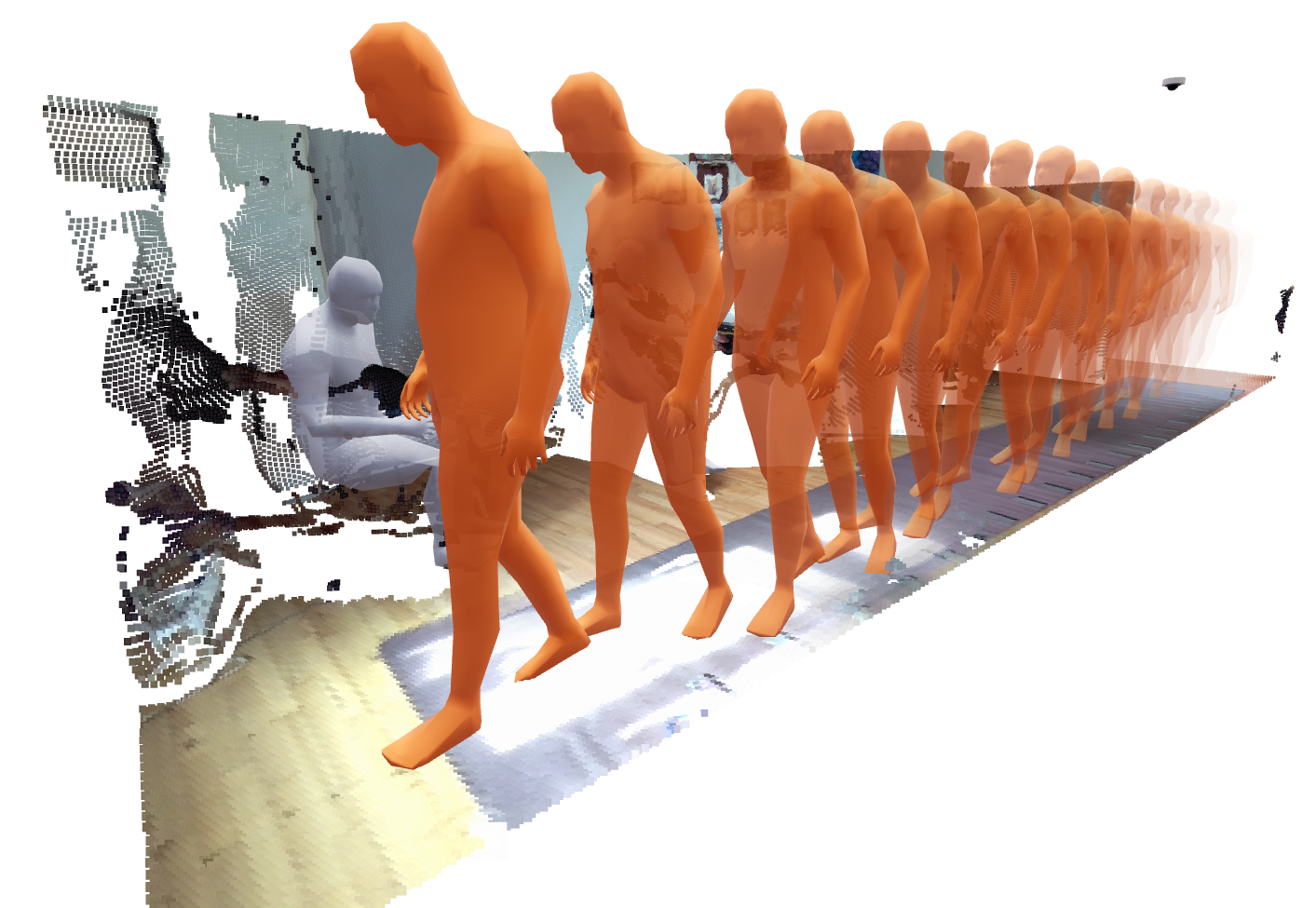
Successive 3D body positions showing a person walking through a room
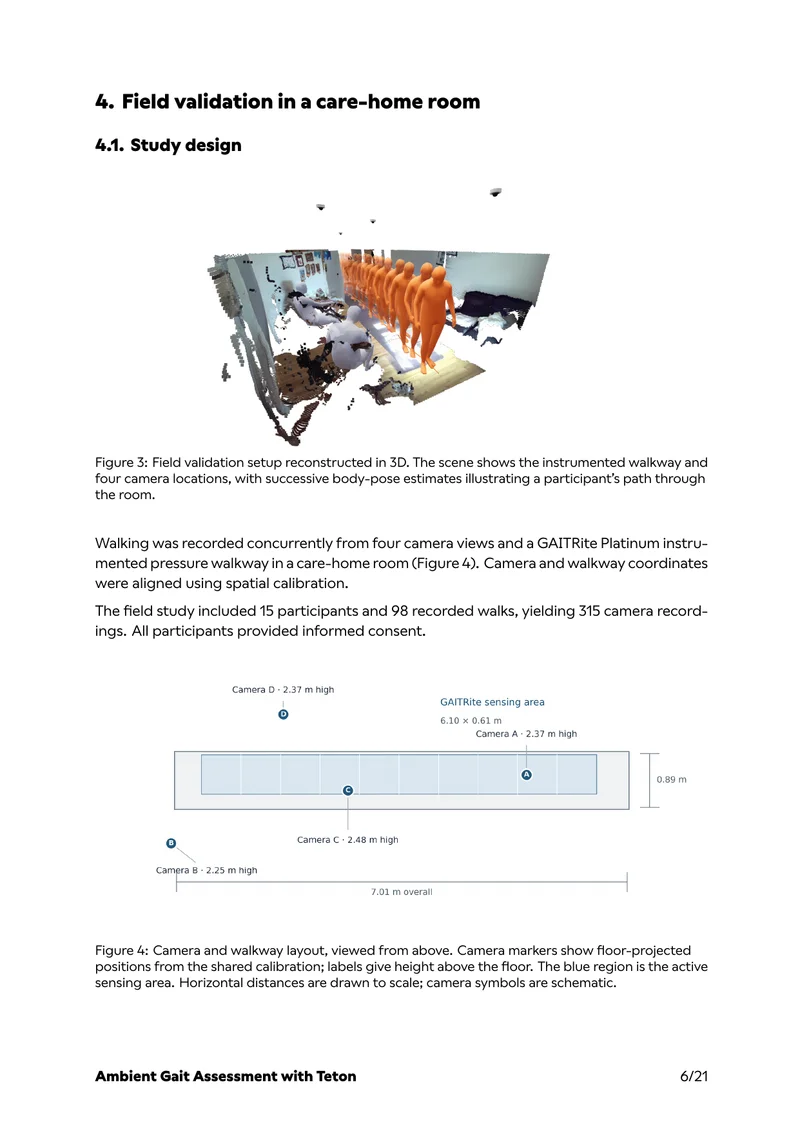
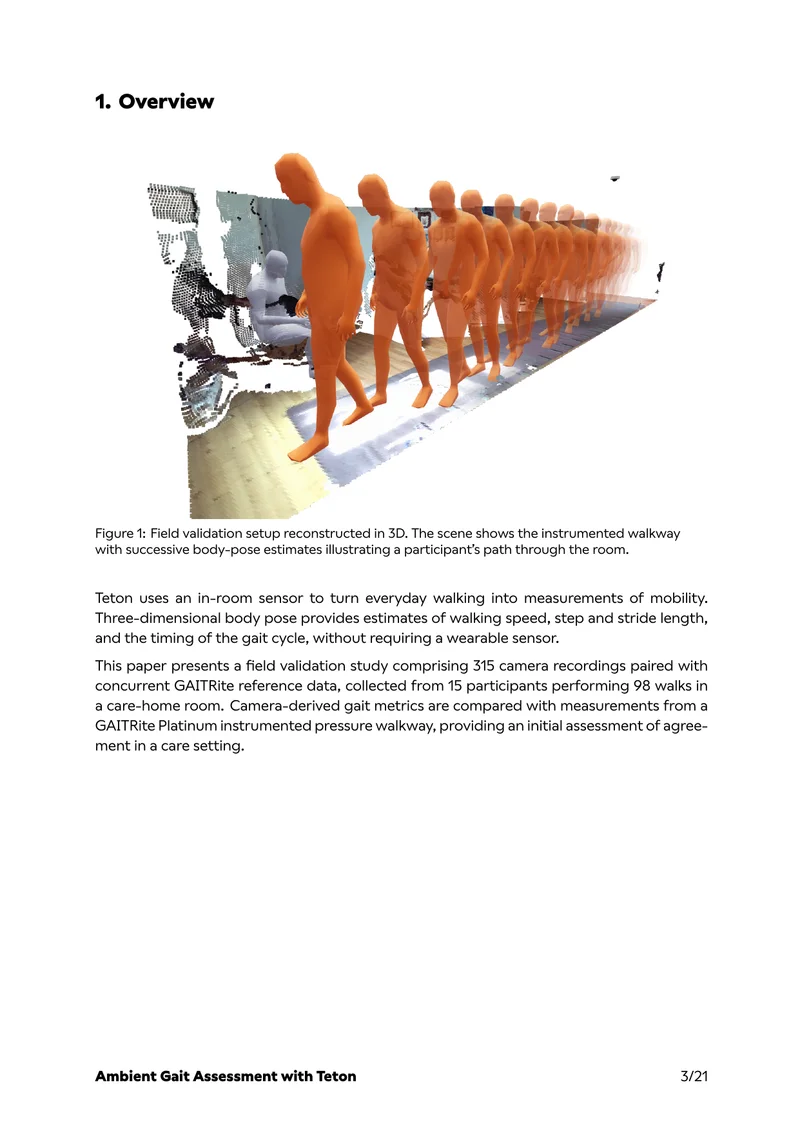
Field validation setup reconstructed in 3D. The scene shows the instrumented walkway with successive body-pose estimates illustrating a participant’s path through the room.

The way we walk reveals a great deal about our mobility and overall wellbeing. Changes in walking speed, step length, and mobility aid usage can provide early signs of declining mobility or poor recovery after a fall, often before those changes become obvious in everyday care.

Today, care teams largely rely on occasional observations and scheduled assessments to understand a resident's mobility. A walk down the hallway, assistance getting out of a chair, or a physiotherapy appointment offers valuable insights, but captures only a small fraction of how a resident moves throughout the day.

Teton helps fill these gaps by automatically measuring gait during everyday walking, using ambient sensors already installed in care homes. By tracking mobility over time, care teams gain a more complete picture of each resident's mobility, helping them recognize changes earlier and provide more personalized, proactive care.

What walking reveals about our health

The way we walk can tell us a surprising amount about our health. Walking speed, for example, is considered such a useful indicator of overall health that it is sometimes referred to as the “sixth vital sign” [1]. Research involving more than 34,000 older adults has even found an association between walking speed and survival [2].

Our gait, the manner we walk, has more to it than how fast we move. Step length, timing and rhythm describe different aspects of mobility that can be linked with aging, neurological conditions and falls [3, 4, 5, 6].

Importantly, gait is not static. It can change gradually as strength, balance, or confidence decline, or more suddenly following an illness or fall. These changes may be difficult to recognize from occasional observations, particularly when they develop over weeks or months.

This makes everyday walking a valuable source of information for care teams. By measuring gait consistently over time, it becomes possible to establish what is normal for each resident and recognize meaningful deviations from their usual patterns. These insights can help care staff and physiotherapists identify emerging mobility concerns, monitor recovery, and make more informed care decisions.

Gait measurement built into the room

Teton’s gait measurements build on top of the technology and hardware already installed in care homes. Residents do not need any wearables, carry phones, attach visual markers or initiate a directed test. The residents or staff do not need to remember to charge any batteries and we do not install any additional gait-specific equipment in the room.

Instead, the Teton system estimates the resident’s body movement in 3D over time. It identifies the steps within a walk, and uses their timing and position to calculate gait measurements. It is able to extract mobility information, usually gathered during a dedicated assessment, into the place where a resident already lives. All of this happens automatically in the background, without requiring residents or staff to do anything.

Select a method to see how it works.

Teton

Teton ambiently collects gait data from markerless motion capture during daily living. It uses the sensors already installed in the room, so there is no extra hardware to set up and nothing for residents to wear, carry or remember to charge.

  • No carried equipment requiredYes
  • No dedicated test area required2Yes
  • No expert supervision requiredYes
  • Captures everyday walkingYes
  1. 1 Reflective body markers.
  2. 2 Test area means a space set aside for assessment, including a temporary walkway.
  3. 3 Varies by device, software and protocol.

Tested against a clinical reference in the field

We compared our remote gait measurement performance against results published by Apple for the iPhone [7], Google for the Pixel Watch [8], and OneStep’s smartphone application [9].

To test Teton in a real care setting, we placed a GAITRite pressure walkway, a clinical-grade reference system, in a care home room. Participants walked from one end of the mat to the other while both systems recorded at the same time. The animation below shows this setup: footsteps detected by Teton appear as a purple contact glow in the 3D scene, while footsteps recorded by GAITRite are shown in orange at their location on the mat’s pressure-sensing area.

3D animation of Teton’s on-device footstep detection during data collection, with synchronized reference data from the GAITRite system.

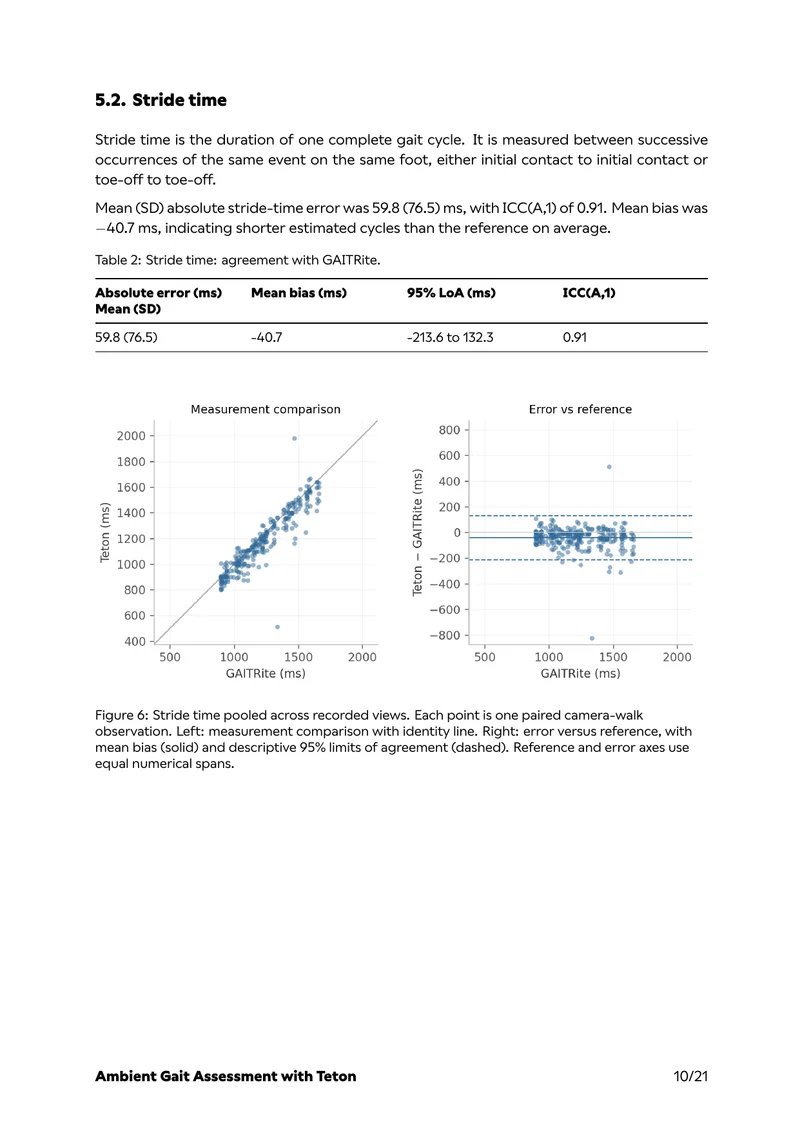
In our field validation study, we found strong agreement between Teton and the GAITRite reference system for walking speed, step and stride timing and length. As Table 1 shows, Teton’s accuracy is comparable to, and on several measures better than, published results from Apple, Google and OneStep.

Table 1. Selected published gait measurement results
MetricTetonApple
[7]
Google
[8]
OneStep
[9]
Walking speed standard deviation (SD) of absolute error (m/s) ↓0.0900.150——
Stride length absolute mean bias (m) ↓0.063——0.091
Walking speed absolute mean bias (m/s) ↓0.085——0.095
Walking speed Pearson correlation coefficient ↑0.974—0.880.97
Walking speed intra-class correlation coefficient (ICC) ↑0.960.920.880.96
Step length ICC ↑0.860.840.830.90
Details

Lower SD of absolute error and absolute mean bias, and higher ICC and Pearson r, are favourable. Pearson r describes association rather than absolute agreement. Bold: Teton; green: favourable (or tied) to all exact comparator values shown in that row. Apple: validation set, 179 participants [7]. Google: Pixel Watch, 246 participants, segment-level ICC; step-length ICC was 0.83 for each side [8]. OneStep: pooled conditions, 20 healthy adults, thigh-mounted iPhones versus Vicon [9]. Teton and Apple use ICC(A,1); Google does not specify the ICC form, and OneStep reports inter-system ICC. Populations, protocols, aggregation and reference systems differ. These selected statistics do not establish overall superiority.

Smartphones and smartwatches have shown that useful gait measurements can come from everyday devices. For Teton, the practical advantage is that these measurements are collected through an existing in-room device and do not require the resident to wear, charge or manage anything.

Please read our technical whitepaper Ambient Gait Assessment with Teton where we describe the study and results in full.

White paper cover: Ambient Gait Assessment with Teton
White paper page 3: Overview
White paper page 6: Field validation study design
White paper page 10: Walking speed results

Technical white paper

Ambient Gait Assessment with Teton

Study design, statistical methods and full results · 21 pages

Read the white paper (PDF)

Turning gait measurements into better care

For care staff, tracking mobility over time provides a fuller picture of how residents move throughout their day. Changes in walking speed or step length that might go unnoticed during brief encounters become easier to observe when compared with a resident's usual walking patterns.

For physiotherapists, everyday gait measurements offer additional context between appointments, making it possible to follow mobility trends and see how walking patterns evolve outside supervised sessions.

Available directly in the Teton app, these measurements complement everyday observations and help care teams build a more complete understanding of each resident's mobility.

Prince Ahir, physiotherapist at Nightingale Hammerson

“Having worked closely with the Teton team, I have seen firsthand how important it is to bridge the gap between advanced technology and practical clinical application. The ability to continuously monitor mobility and quantify changes over time, without additional equipment or testing protocols, represents a significant step forward.

These measures complement traditional visual assessment by providing objective data that can highlight emerging concerns, track rehabilitation outcomes, and support earlier intervention when mobility begins to change. I believe this approach has the potential to make mobility monitoring more accessible, consistent, and impactful across a wide range of care settings.”

Prince Ahir

Physiotherapist at Nightingale Hammerson, UK

The examples below illustrate how everyday walking can reveal changes in mobility over time. Each follows a resident over 14 days, tracking walking speed, stride length, double support time, and forward trunk lean. Teton also automatically records events such as falls and walking aid use, alongside other measurements like sleep and respiration, providing a more complete picture of daily activity and wellbeing.

By comparing each resident's measurements with their own earlier patterns, changes become easier to recognize.

Select a resident to explore their story.

Resident story: The resident started using a walking aid on day 7. From that point, forward trunk lean rose from around 6° to almost 20°. Over the same period, walking speed and stride length decreased, and the resident spent a larger share of each stride with both feet on the ground.

Daily values · Day 14

Walking speed
0.28 m/s
Stride length
0.66 m
Double support time
36.6 %
Forward trunk lean
17.1 °
Day 7: Started using a walking aidWalking speed (m/s)0.240.380.51Pre-event baseline: 0.44 m/s1234567891011121314DayStride length (m)0.620.760.90Pre-event baseline: 0.81 m1234567891011121314DayDouble support time (%)20.631.041.4Pre-event baseline: 27.0 %1234567891011121314DayForward trunk lean (°)3.612.721.7Pre-event baseline: 6.5 °1234567891011121314Day

Dotted lines show the average of available measurements before day 7, excluding the event day. Shading shows the difference between daily measurements and that baseline. For the walking-aid example, the baseline is the period before the aid was introduced; for the fall examples, it is the pre-fall period.

Double support time is the percentage of the gait cycle with both feet on the ground. Each chart has its own vertical scale. Dots mark measured days; across days without measurements, the line connects the readings on either side.

A fuller picture of everyday mobility

Our field validation demonstrates that Teton can accurately measure key gait characteristics during everyday walking. Built on the sensors already installed in care homes, these measurements require no wearables, additional equipment, or dedicated assessments.

By capturing walking patterns in residents' own rooms, Teton extends mobility observation beyond occasional staff encounters and scheduled assessments. Over time, these measurements provide care teams with a more complete, objective picture of how each resident moves, complementing their everyday observations and understanding of the resident.

Why Residents Fall: What Happens in the Five Minutes Before

Falls often seem sudden. But the minutes before them tell a different story.

Read post
See gait assessment in action

Discover how Teton brings everyday mobility into your care team’s view.